What Does a Negotiable Instrument Need?
📅 2026 Update: Changes in Negotiable Instruments
Since the original article was published, there have not been any major updates to the laws governing negotiable instruments from 2024 to 2026. However, readers should be aware of some key aspects that remain relevant. The need for understanding the current landscape of negotiable instruments continues to be important for businesses and individuals alike.
Below are some significant points to consider about negotiable instruments in the context of U.S. business law.
📜 Uniform Commercial Code (UCC) Revisions
The Uniform Commercial Code (UCC) governs negotiable instruments and is subject to periodic revisions. The last major update occurred in 2020, focusing on electronic records and signatures. No major updates have been made since then, as of October 2023.
💰 Current Fees and Costs
Banks often charge various fees for processing negotiable instruments. For instance, a bank may impose a $30 fee for returned items and $35 for stop payment orders. These fees can impact businesses that frequently use checks and drafts.
🕒 Processing Times
Under the Expedited Funds Availability Act, funds from deposited checks must be available within one to five business days. The time frame depends on the type of check and the deposit method, which is crucial for businesses managing cash flow.
📅 Deadlines and Statute of Limitations
Understanding the deadlines for enforcing negotiable instruments is critical. For notes, the statute of limitations is six years, while drafts, such as checks, have a three-year limit. Missing these deadlines can result in losing the ability to enforce payment.
📌 Key Points Summary
- 📜 UCC revisions last updated in 2020; no major changes since.
- 💰 Bank fees may include charges for returned items and stop payments.
- 🕒 Check clearing times can take one to five business days.
- 📅 Statute of limitations is six years for notes and three years for checks.
💡 Tips for Managing Negotiable Instruments
Review the specifics of your situation with your attorney.
📑 Understand Your Instruments
Know the different types of negotiable instruments, such as checks and promissory notes. Each type has unique features and requirements.
✍️ Proper Endorsements
When transferring a negotiable instrument, ensure you endorse it correctly by signing the back. This step is necessary for the new holder to claim the funds.
🏦 Choose the Right Bank
Select a bank that offers favorable terms for processing negotiable instruments. Compare fees and services to find one that fits your business needs.
🔍 Monitor Fees
Regularly check for any bank fees associated with your negotiable instruments. Understanding these charges can help you manage your business finances more effectively.
🛡️ Implement Fraud Prevention
To protect your business, use measures like positive pay services. These services match checks presented for payment against a list of issued checks, helping to detect fraud.
🏆 Ranked by User Reviews (2026)
This section highlights services that relate to negotiable instruments, focusing on financial products and credit services. The order is based on Trustpilot data as of October 2026. Ratings can change, and while star ratings are a helpful metric, they may not fully reflect customer experiences.
🥇 1. MEXEM Europe
MEXEM Europe has been rated 4.8. This service is known for investment brokerage and provides access to global financial markets. Some users report issues with order execution times, which can affect the timely use of funds in transactions involving negotiable instruments.
🥈 2. Experian
Experian holds a Trustpilot score of 4.1. It is recognized for credit report services and credit monitoring, which are essential for businesses using negotiable instruments. However, some users express concerns regarding customer service responsiveness, which can impact user satisfaction.
🆓 Free Government and Nonprofit Help
The Consumer Financial Protection Bureau (CFPB) offers resources related to financial products, including negotiable instruments. Additionally, legal aid organizations provide free or low-cost legal assistance, helping individuals facing issues with negotiable instruments, such as disputes over checks.
🔎 Choosing the Right Service
- 🏦 Fees associated with processing.
- 🏅 Review scores on platforms like Trustpilot.
- ⚙️ Services offered, such as monitoring or dispute resolution.
- ⌛ Response times for customer service inquiries.
❓ Frequently Asked Questions
❓ What are negotiable instruments?
Negotiable instruments are written documents guaranteeing the payment of a specific amount of money to a specified person or bearer. Common types include checks and promissory notes.
📄 How do I issue a negotiable instrument?
To issue a negotiable instrument, provide a signed document that specifies the amount to be paid and includes the date and signatures.
🏦 What bank fees should I expect?
Fees can vary by bank, including charges for returned items and stop payment orders. It is essential to check with your bank for the specific fees applicable to your account.
📅 How long does it take for a check to clear?
Under the Expedited Funds Availability Act, checks typically clear within one to five business days. The exact time depends on the check type and deposit method.
📉 What is the statute of limitations for checks?
The statute of limitations for enforcing checks (drafts) is three years. For other types of negotiable instruments, such as notes, it is six years.
👮 How can I prevent check fraud?
Implement measures such as positive pay services, which match checks presented for payment against a list of issued checks to help detect discrepancies and prevent fraud.
⚖️ Recent Cases Involving Negotiable Instruments
Recent court rulings related to negotiable instruments illustrate how laws are applied in various situations. These cases can impact how businesses handle checks and other instruments.
- Court rules against Seabee Construction in bid protest caseUnited States Court of Federal Claims · July 2, 2026
- Hawaii Supreme Court rejects Bank of New York's appealHawaii Supreme Court · July 7, 2026
- Court Rules on Massman Construction's Bid Protest Against USACEUnited States Court of Federal Claims · July 7, 2026
- Court Denies Toota Group's Bid Protest Against U.S. ArmyUnited States Court of Federal Claims · July 6, 2026
For more recent rulings, you can browse more rulings on the news page.
End of October 2026 Update
Negotiable Instruments
Negotiable instruments do not have to come in the simplified forms with which most people are familiar. Checks, for instance, are negotiable instruments that essentially have a common set of terms and understanding applied to each and every one, but in theory those terms could be written out as an actual contract.
Clearly, then, there is a form for such contracts to follow in their writing that would define them as negotiable instruments, and most negotiable instruments effectively imply those fully written contracts by satisfying the requirements for being negotiable instruments under Article 3 of the Uniform Commercial Code.
The requirements are varied, but designed to be specific and rigid, such that negotiable instruments are clearly defined and understood without any confusion. For example, negotiable instruments must, of necessity, be unconditional orders for payment.
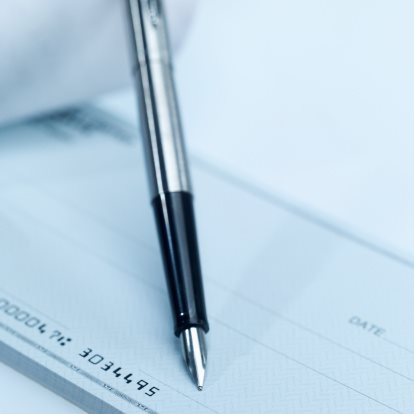
A negotiable instrument cannot hinge payment directly upon some other condition or contract, such as in a deal where payment would only be made if the goods being purchased were found to be satisfactory and non-defective. Such a contract would not be a negotiable instrument.
Negotiable instruments can involve the delay of payment until conditions are met, but payment will be made on a negotiable instrument unless the instrument is annulled in other clearly described ways. Negotiable instruments also must be made in written form and cannot be oral contracts. They must also have clearly defined elements of when the payment must be made available. Follow the link for more information on the basic requirements of the implicit negotiable instrument form.
Signature Requirements
In order to function, negotiable instruments must have the appropriate signatures attached. The necessary signatures will vary depending upon whether or not the negotiable instrument is an order or a promise and who the parties involved may be. A check, for instance, as a draft in which the drawee is inherently determined to be a bank will require a different set of signatures than will a promissory note like a loan.
The primary uniform requirement of all negotiable instruments is that they be signed by the issuer. For example, a check must be signed by the person writing the check, the drawer. A promissory note must be signed by the person accepting the debt and promising to pay back the other party. Without such a signature, no negotiable instrument would be viable or enforceable. These signatures also do not necessarily have to be signatures of the most generally understood sort, but instead need only be some sort of stand-in official identifier of endorsement from the issuer.
Many negotiable instruments require additional signatures, however. Any check or draft which is made as a pay to order negotiable instrument will inherently require an endorsement signature from the payee in order to be made functional, for example. Click the link for more information on the signature requirements of negotiable instruments.
Promise or Order
Any given negotiable instrument will be, of necessity, either a promise to pay or an order to pay. A promise to pay involves two parties, generally, with one party promising to pay the other a specified sum of money at a specified time. An order to pay, on the other hand, involves three parties with the issuer of the order, the drawer, ordering a second party, the drawee, to pay a third party, the payee.
The primary difference between the two is that an order to pay involves not debt, but payment out of the resources of an intermediary party. A promise to pay, on the other hand, is indicative of debt, and not direct, immediate payment. Orders to pay are generally called drafts, and promises to pay are called promissory notes.
Promissory notes are often used for loans and can include terms concerning interest payments on the initial sum of money. The notes' issuers would be making a promise to pay back the loan on a specific date along with a specific amount of interest accrued over that time period.
Drafts, or orders to pay, are most commonly known in the form of checks, which are drafts in which the drawee is defined as a bank. Drafts are often used in business dealings, however, as payments for an exchange of goods.
This is because specialized terms can be added to drafts in order to make them more useful for such deals, such as specific terms on payment only being made available a certain amount of time after the transfer of goods. For more information on the differences between promises and orders and the importance of both, follow the link.
Established Amount Of Money
All negotiable instruments must be made for a determined amount of money. Any contract of exchange which uses an indeterminate or variable sum of money would not be a negotiable instrument, inherently.
This isn't to say that negotiable instruments cannot have some form of variation, as would be provided through the practice of interest on a promissory note, because such variation is actually determined through a pre-set formula and is based on the original static amount of money. The primary reason for negotiable instruments to involve such a pre-set established amount of money is to ensure that they are well-defined and clear.
Negotiable instruments are not open to interpretation, as the terms and characteristics of any given negotiable instrument are likely to be determined simply by its nature as a certain type of negotiable instrument. As such, if the negotiable instrument could be made for a variable amount of money, it would detract strongly from the overall definition of the negotiable instrument. To find out more about the use of established amounts of money within negotiable instruments, follow the link.
Time Requirements
One of the defined qualities of negotiable instruments is that they must involve a specific date or time when the negotiable instrument will be made payable. This is in some ways misleading, as the specific date or time when the negotiable instrument must be made payable can be dependent upon other factors.
For example, the specific date or time might simply come after a defined interval from the date upon which the instrument is originally "sighted" or accepted by a bank. It might also come some time period after the goods exchanged within the transaction have arrived at the buyer's location so as to help secure the overall transaction by preventing the seller from taking the money without sending the goods.
The time requirements of negotiable instruments are primarily focused on preventing the same kind of indeterminacy that might arise from not having an established amount of money. Without a clearly defined date for the transfer of money, it is possible that those who make promissory notes would be able to avoid ever having to pay off their debts.
The time requirements of negotiable instruments are designed to prevent such shirking of debts. For more information on the time requirements inherent to negotiable instruments, click the link.
Pay to Order or Bearer
Every negotiable instrument must be designed to either pay to order or to bearer, without exception. The difference between the two is relatively simple, as an instrument made to pay to bearer is payable to whomsoever holds the physical documentation of the instrument, while an instrument made to pay to order is payable only to the person or party identified in the negotiable instrument.
If the person or party identified on the negotiable instrument is nonexistent, then that instrument would not actually be negotiable. But if, instead, there is no party or person identified on the negotiable instrument, then it is assumed to be payable to bearer. If the instrument is made payable to cash, then it is similarly payable to the bearer.
Any negotiable instrument that is payable to the bearer is more dangerous for the payee than one that is pay to order. This is because a payable to bearer instrument is, essentially, money in and of itself; the document is all that is necessary to receive payment.
Thus, if the document is stolen, then the thief would be able to use it to receive payment without the drawee having any notion that the document was stolen. If the thief were later caught, then one could likely receive some form of restitution from the thief, but the drawee him or herself would not be held liable in such a case.
Pay to order instruments, on the other hand, can only be used for payment when they have the specific endorsement of the party mentioned on the instrument. As such, they are generally safer than pay to bearer instruments. Follow the link for more information on the differences between pay to order instruments and pay to bearer instruments.
Bearer Instruments
Bearer instruments are those negotiable instruments that are payable to the bearer and not to order. There are many ways to establish a bearer instrument, including failing to define the person or party to whom the instrument is payable and making the instrument out to cash.
Bearer instruments have their uses, mostly because they are easy to use and transfer; simply handing over the document of a bearer instrument is enough to transfer the funds involved. This is fortunate for ease of use and also for those situations in which the party to pay is unclear. For instance, a prize check might be made out to cash so that it can be bestowed upon any bearer instead of a specific one.
But bearer instruments then have the inherent flaw of being easily stolen, as any party holding the bearer instrument can use it to receive funds without the drawee being able to tell if the instrument is stolen or not. Whether or not this flaw outweighs the benefits is a decision to be made by any given issuer of a negotiable instrument.
Even pay to order negotiable instruments are not entirely safe from the flaws of bearer instruments, as a pay to order negotiable instrument with an endorsement can be stolen in the same fashion as a bearer instrument. To find out more about the advantages and flaws of bearer instruments, click the link.